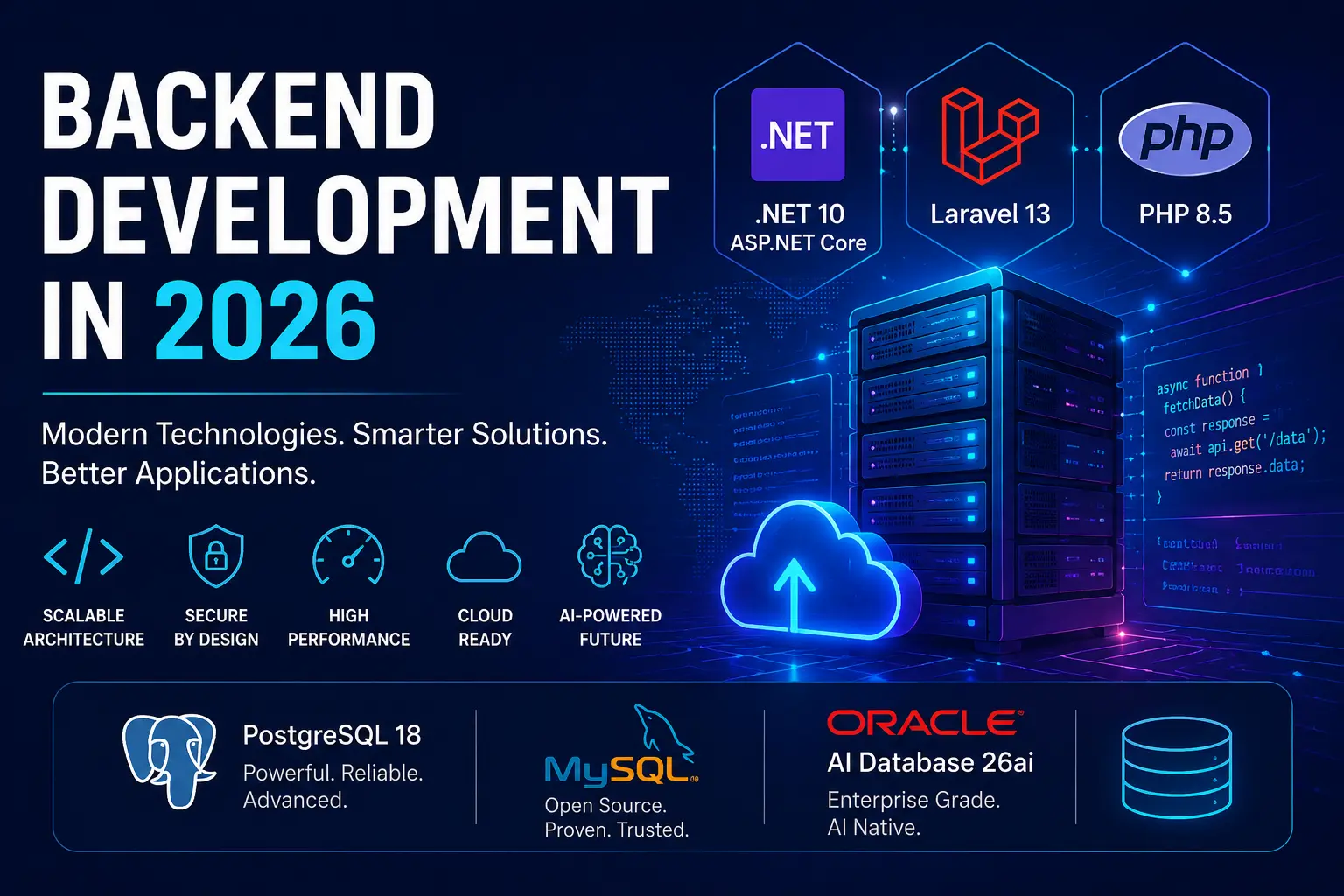
Modern backend development is changing rapidly. Businesses no longer need applications that simply store data and display web pages. They expect secure APIs, intelligent search, real-time communication, cloud scalability, excellent performance, and seamless integration with artificial intelligence.
In 2026, technologies such as ASP.NET Core on .NET 10, Laravel 13, PHP 8.5, PostgreSQL 18, MySQL, and Oracle AI Database 26ai are giving developers more powerful ways to build these systems.
However, choosing the newest technology is not always the right decision. A successful project starts by choosing the stack that best matches its business requirements, expected traffic, budget, security needs, and long-term maintenance plan.
What Has Changed in Backend Development?
Backend development was once mainly focused on processing forms, managing sessions, and performing database operations. Today, the backend is responsible for much more:
-
REST and JSON APIs
-
Mobile application backends
-
Real-time notifications
-
Authentication and authorization
-
Background job processing
-
Cloud deployment
-
AI model integration
-
Semantic and vector search
-
Monitoring and observability
-
Automated scaling
-
Data privacy and application security
As systems become more complex, developers must think beyond programming languages. Architecture, database design, caching, queues, security, testing, deployment, and monitoring are now equally important.
ASP.NET Core and .NET 10
.NET 10 is Microsoft’s current Long-Term Support release and provides a strong foundation for enterprise-grade applications.
ASP.NET Core 10 introduces improvements across Minimal APIs, OpenAPI support, Blazor, diagnostics, validation, and authentication. Microsoft has also added passkey-related capabilities to ASP.NET Core Identity, helping developers move toward more secure passwordless authentication experiences. [1]
Why Choose ASP.NET Core?
ASP.NET Core is particularly suitable for:
-
Enterprise business applications
-
High-performance APIs
-
Banking and financial systems
-
Large administrative platforms
-
Microservice architectures
-
Applications requiring strict type safety
-
Systems integrating with Microsoft technologies
C# offers strong typing, excellent asynchronous programming support, mature development tools, and a large ecosystem. ASP.NET Core applications can also run across Windows, Linux, containers, and cloud platforms.
Entity Framework Core 10 complements this stack by providing modern object-relational mapping features. Because EF Core 10 targets .NET 10, teams can build applications around a consistent long-term support lifecycle. [2]
Best Use Case
ASP.NET Core is a strong choice when application reliability, maintainability, performance, and structured enterprise development are more important than rapid prototyping alone.
Laravel 13 and AI-Native PHP Development
Laravel remains one of the most productive frameworks for building PHP applications. Laravel 13 continues the framework’s annual release cycle with a noticeable focus on AI-native development.
The release introduces first-party AI primitives, semantic and vector-search capabilities, JSON:API resources, and improvements to queues, caching, security, and developer APIs. [3]
This is an important shift. AI features are no longer separate experiments added at the end of a project. They are becoming part of normal application architecture.
Why Choose Laravel?
Laravel is an excellent option for:
-
Business portals
-
E-commerce applications
-
Content-management systems
-
Booking platforms
-
SaaS products
-
Custom dashboards
-
REST APIs
-
Rapid minimum viable products
Laravel provides routing, validation, authentication, database migrations, queues, events, scheduled tasks, notifications, caching, and testing tools in a consistent framework.
Its expressive syntax allows developers to deliver features quickly without sacrificing application structure.
Laravel and Modern Frontends
Laravel can support traditional server-rendered applications as well as modern frontend architectures. Depending on the project, it can be combined with Livewire, Vue, React, Svelte, or a dedicated mobile application.
This flexibility makes Laravel suitable for both small businesses and larger products that need to evolve over time.
PHP 8.5: Cleaner and Safer Application Code
PHP 8.5 is a major language update rather than a simple maintenance release. It introduces features designed to improve code readability, API safety, and URL handling.
Important additions include:
-
A built-in URI extension
-
The pipe operator
-
Property modification while cloning objects
-
The
NoDiscardattribute -
Persistent cURL share handles
-
Expanded support for closures and first-class callables in constant expressions [4]
The pipe operator is especially useful when a value must pass through several transformations. Instead of deeply nested function calls, developers can write processing steps in a more readable left-to-right sequence.
The new URI extension also provides standardized APIs for parsing and manipulating URLs according to established URI and web URL standards.
Should Existing PHP Applications Upgrade?
Upgrading should be planned rather than rushed.
Before upgrading a production application:
-
Review framework and package compatibility.
-
Run automated tests.
-
Check deprecated language features.
-
Test queues, scheduled jobs, and command-line scripts.
-
Benchmark important application workflows.
-
Deploy first to a staging environment.
-
Maintain a rollback strategy.
A newer PHP version can improve code quality and provide useful capabilities, but application stability must remain the priority.
PostgreSQL 18 for Performance and Advanced Search
PostgreSQL 18 is the current major PostgreSQL release, with PostgreSQL 18.4 available as of May 14, 2026. [5]
The PostgreSQL 18 release introduced a redesigned asynchronous I/O subsystem intended to improve storage-reading performance. It also expanded the range of queries that can benefit from indexes and reduced disruption associated with major-version upgrades. [6]
PostgreSQL is particularly valuable for applications that require:
-
Complex relational data
-
Advanced SQL
-
JSON and structured data together
-
Full-text search
-
Geographic data
-
Reporting and analytics
-
Strong transactional consistency
-
Vector-search integrations
PostgreSQL for AI Applications
Many AI-enabled applications need to compare embeddings rather than perform traditional keyword matching. This makes vector and semantic search increasingly important.
A typical AI-enabled search system may:
-
Convert documents or product descriptions into embeddings.
-
Store those embeddings alongside normal business data.
-
Convert a user’s query into another embedding.
-
Compare it against stored vectors.
-
Return the most semantically relevant records.
-
Apply business rules, permissions, and structured filters.
This approach can support knowledge bases, intelligent product search, recommendation engines, document discovery, and customer-support assistants.
MySQL Remains a Practical Business Database
MySQL remains a popular choice for web applications, especially in the PHP ecosystem.
It is commonly used for:
-
E-commerce websites
-
Content platforms
-
Customer portals
-
Inventory systems
-
WordPress applications
-
Laravel applications
-
Small and medium-sized SaaS platforms
MySQL is often selected because hosting support is widely available, administration tools are familiar, and many development teams already understand its operational model.
The best database is not necessarily the one with the longest feature list. For many projects, familiarity, deployment simplicity, backup procedures, monitoring, and developer experience matter just as much.
Oracle AI Database 26ai for Enterprise Systems
Oracle’s current database platform is Oracle AI Database 26ai. Oracle describes it as a long-term support release replacing Oracle Database 23ai, with AI Vector Search and other AI-related capabilities included in the platform. [7]
Oracle AI Database 26ai is particularly relevant to organizations that already depend on Oracle for mission-critical systems.
Common use cases include:
-
Banking systems
-
Government platforms
-
Telecommunications
-
Enterprise resource planning
-
Large-scale reporting
-
Highly regulated applications
-
Critical transactional workloads
Oracle also provides an Oracle AI Database 26ai Free edition for development and learning, with limited CPU, memory, and storage capacity. [8]
For enterprise projects, the database decision is frequently influenced by existing infrastructure, licensing, compliance, internal expertise, and integration requirements.
Which Backend Stack Should You Choose?
There is no universal winner.
Choose ASP.NET Core when:
-
You need an enterprise-grade architecture.
-
Your team prefers C# and strong typing.
-
High performance is a major requirement.
-
The application integrates with Microsoft services.
-
Long-term maintainability is essential.
Choose Laravel when:
-
Rapid development is important.
-
The project is a business portal, SaaS product, or custom web application.
-
You want a productive framework with many built-in tools.
-
Your team has strong PHP experience.
-
The application may use Livewire, Vue, React, or Svelte.
Choose PostgreSQL when:
-
Your data model is complex.
-
Advanced querying is important.
-
You need strong JSON, search, analytics, or geospatial capabilities.
-
The application may introduce semantic or vector search.
Choose MySQL when:
-
Simplicity and broad hosting support are priorities.
-
Your application uses Laravel, PHP, or a popular CMS.
-
Your team already has operational experience with MySQL.
-
The workload follows familiar transactional patterns.
Choose Oracle when:
-
The system is enterprise-critical.
-
Oracle is already part of the organization’s infrastructure.
-
Compliance, auditing, availability, and enterprise support are major requirements.
-
The project requires deep integration with existing Oracle systems.
A Practical Architecture for 2026
A modern backend architecture does not need to begin as dozens of microservices.
For many projects, a well-structured modular application is the better starting point.
A practical architecture may contain:
-
A Laravel or ASP.NET Core backend
-
REST or JSON APIs
-
PostgreSQL, MySQL, or Oracle as the main database
-
Redis for caching and temporary data
-
Background workers for slow operations
-
Object storage for files and media
-
Centralized logging and monitoring
-
Automated tests
-
Continuous integration and deployment
-
Containerized deployment where appropriate
Microservices should be introduced only when there is a clear operational or organizational reason. Dividing a small application into many services too early can increase deployment complexity, network failures, debugging effort, and infrastructure cost.
Security Must Be Designed from the Beginning
Security is not a feature that should be added immediately before launch.
Every production application should include:
-
Server-side validation
-
Parameterized database queries
-
Strong authentication
-
Role- and permission-based authorization
-
Secure password hashing
-
Rate limiting
-
CSRF protection where applicable
-
Output encoding
-
Secure file-upload validation
-
Dependency updates
-
Audit logging
-
Encrypted connections
-
Tested backup and recovery procedures
AI-generated code should receive the same review, testing, and security analysis as manually written code. Faster development should never mean weaker engineering standards.
Performance Is More Than Application Speed
A fast programming language cannot compensate for inefficient architecture.
Backend performance commonly depends on:
-
Database indexes
-
Query design
-
Pagination
-
Avoiding unnecessary database calls
-
Caching strategy
-
Background processing
-
Network latency
-
Asset and response compression
-
Connection pooling
-
Memory allocation
-
Monitoring slow requests
Developers should measure real application behaviour before attempting optimization. Profiling, logs, database execution plans, and production metrics are more reliable than assumptions.
The Role of AI in Software Development
AI tools can help developers generate boilerplate, explain unfamiliar code, draft tests, suggest documentation, and accelerate research.
However, experienced developers remain responsible for:
-
Architecture
-
Data modelling
-
Security
-
Business-rule correctness
-
Performance
-
User privacy
-
Deployment
-
Code review
-
Maintenance
The strongest development workflow combines AI-assisted productivity with human engineering judgement.
Final Thoughts
Backend development in 2026 is not about replacing one framework with another. It is about combining reliable engineering principles with modern platform capabilities.
.NET 10 provides a powerful long-term foundation for enterprise applications. Laravel 13 brings AI-native workflows into productive PHP development. PHP 8.5 improves language expressiveness and safety. PostgreSQL 18 strengthens performance and advanced data capabilities. MySQL remains practical and widely supported, while Oracle AI Database 26ai serves demanding enterprise environments.
The best technology stack is the one that solves the business problem clearly, securely, efficiently, and sustainably.
A successful application is not defined only by the framework used to create it. It is defined by how well it performs, how securely it protects its users, how easily it can be maintained, and how effectively it supports the organization behind it.